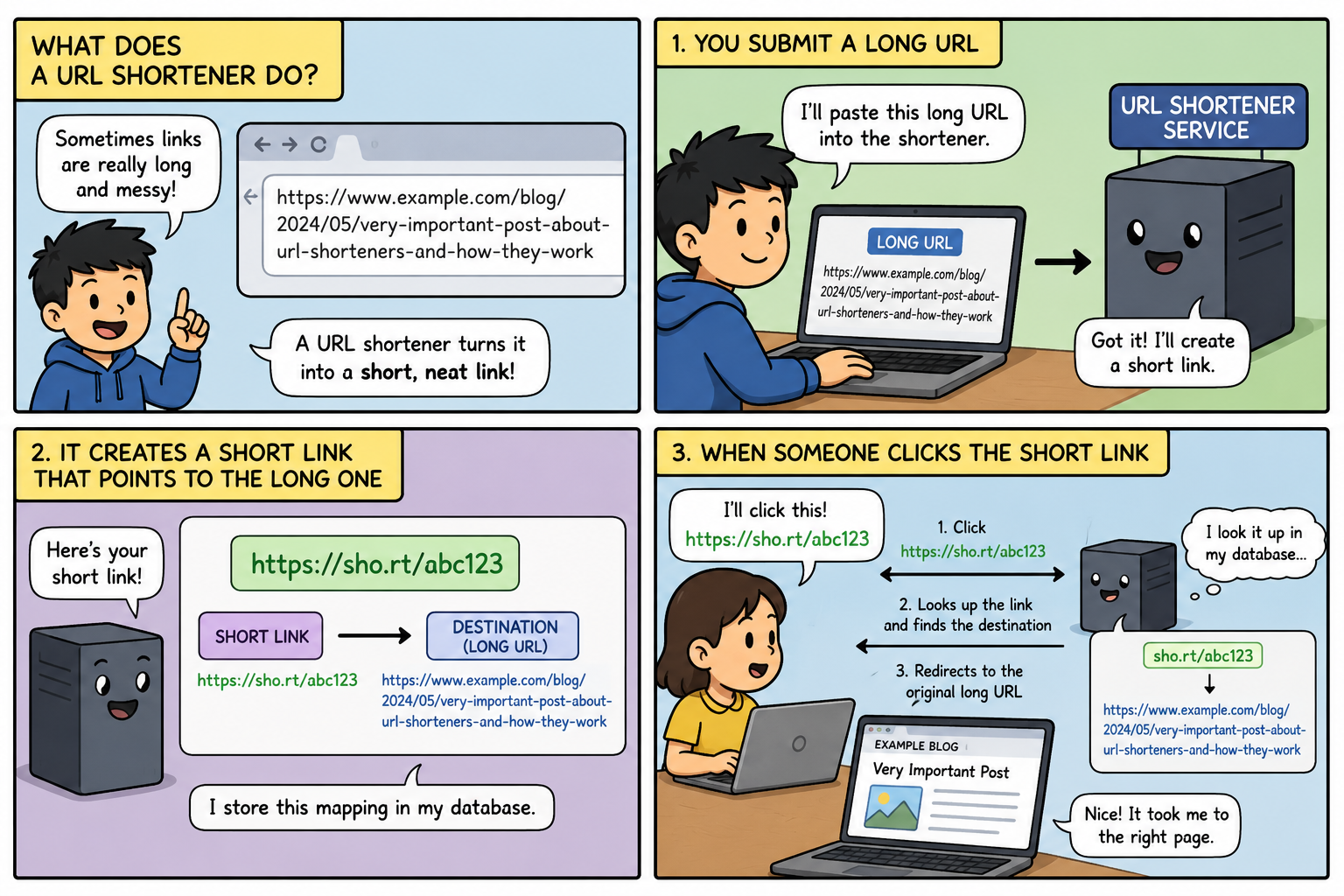
I’ve used URL shortening services like bit.ly and TinyURL, but I’d never once thought about how the technology works up until now. Wanting to understand the logic behind this versatile piece of tech, I decided to implement a version of it using Go.
This write-up covers some of the things I found interesting while implementing this software.
Generating the unique code can be tricky
At a glance, generating the unique code that represents the stored URL feels like a walk in the park. All you have to do is generate a random string of alphanumeric characters. However, as with all engineering projects, your solution can’t “just work in the usual straightforward scenarios” — it has to work in all possible scenarios. A few questions I asked myself while building this:
- What happens if two or more users request a code at the same time?
- How do you prevent malicious actors from guessing generated codes?
- How do you handle a generated code that has already been used for a previous link?
These questions and others ran through my mind as I wrote my code-generation logic. With them in mind,
I implemented a solution that makes use of random code generation via the math/rand package
(this can be made even stronger with crypto/rand), a mutex to guard access within a single process,
and a unique constraint on the code column backed by retry logic.
Repositories are nice until they aren’t
For this project I built two storage options: in-memory and a PostgreSQL database. In-memory is handy when developing and testing the code, and Postgres is for production. This decision meant making use of a layered architecture alongside the repository pattern.
Using a repository meant defining a storage interface so that the application doesn’t care about the internal details of how the data is stored — all it knows is which method to call when carrying out an action on the data.
type Storage interface {
	Save(ctx context.Context, u *models.URL) error
	Get(ctx context.Context, code string) (*models.URL, error)
	LookUp(ctx context.Context, url string) (*models.URL, error)
	IncrementClicks(ctx context.Context, code string) error

	Ping(ctx context.Context) error
}
The pattern made the storage layer maintainable, because each storage backend can implement its own internal logic without having to touch any other part of the codebase. However, the drawback can be seen in the last defined method.
Ping(ctx context.Context) errorPing here is a function the application calls to check whether the Postgres database is ready to receive
queries. It’s useful especially when you consider deploying on a Kubernetes cluster that sends this request
via the GET /ready endpoint.
The problem is that Ping is only relevant to the Postgres database, not to the in-memory storage — and
because each backend has to satisfy the interface by implementing every one of its methods, we’re forced
to write a piece of redundant code.
func (im *MemoryStore) Ping(_ context.Context) error { return nil }This is the Interface Segregation Principle biting: a fat interface forcing a client to implement a method it
doesn’t need. It seems trivial in this codebase, but imagine it in a larger project. Not fun.
The cleaner fix is to split Ping out into its own narrow interface say a HealthChecker
that only the backends which actually support it implement, leaving Storage focused on storage.
At the end of it all…
Implementing this project was fun and really helped me get a better understanding of how URL shortener services work. It also showed me the game of trade-offs we play as engineers trying to implement a solution, and how solutions evolve as more questions arise with complexity and scale.
If you want to have a scan of the codebase, it’s available here.
Till next time, keep solving.